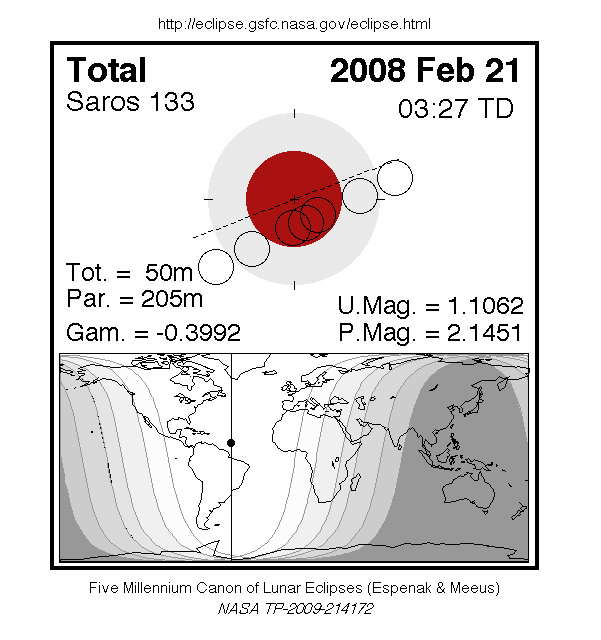
A total eclipse of the Moon occurred on Thursday 21 February, 2008 UT, lasting from 00:36–06:15 UT. A shallow total eclipse saw the Moon in relative darkness for 49 minutes and 48 seconds. The Moon was 11% of its diameter into the Earth's umbral shadow, and should have been significantly darkened for viewers over the Americas, Europe, Africa, and western Asia. The partial eclipse lasted for 3 hours and 25 minutes in total.
The timings of the phases of the eclipse are as
follows. You would have been able to see each phase of the
eclipse if the Moon was up at the corresponding time as
seen from your location; however the penumbral phase
would have been very difficult to see in practice:
| Penumbral eclipse began: |
00:36:37 UT |
| Partial eclipse began: |
01:43:18 UT |
| Total eclipse began: |
03:01:09 UT |
| Maximum eclipse: |
03:26:03 UT |
| Total eclipse ended: |
03:50:54 UT |
| Partial eclipse ended: |
05:08:45 UT |
| Penumbral eclipse ended: |
06:15:35 UT |
During this eclipse the Moon was 7 days after perigee and 7 days before apogee.
At maximum eclipse it was 0.527° in apparent
diameter, which is 0.7% smaller than average.
The statistics page has information on the ranges of the sizes of
the Sun and Moon, and the Moon data page displays detailed
information on the Moon's key dates.
Interactive Map
This map shows the visibility of the eclipse at various stages.
The bright area in the middle saw the whole eclipse; the coloured
bands to the right saw the start of the eclipse, and those on the
left saw the end. Note that the map is approximate, and if you were
near the edge of the area of visibility, the moon was very close to the
horizon and may not have been practically visible.
You can use the zoom controls to zoom in and out, and pan to
see areas of interest. Hover your mouse over the
tags to see what was visible from each area on the map. The green
marker in the centre shows where the Moon was directly
overhead at maximum eclipse.
The interactive map is currently not available.
Overview Map
This map sourced from NASA Goddard Space flight Center: GSFC Eclipse Web SiteGSFC Eclipse Web Site
The primary source of all the information on eclipses presented here at Hermit Eclipse. (NASA Goddard Space flight Center)
shows the visibility of the eclipse. (Click on it for the
full-sized version.)
Eclipse Season and Saros Series
This eclipse season contains 2 eclipses:
This was the 26th eclipse in lunar Saros series 133.The surrounding eclipses in this Saros series are:
This Saros series, lunar Saros series 133,
is linked to solar Saros series 140. The
nearest partner eclipses in that series are:
Eclipse Parameters
| UT Date/time (max) | 03:26:03 on 21 Feb UT |
TDT Date/time (max) | 03:27:09 on 21 Feb TDT |
| Saros Series | 133 |
Number in Series | 26 |
| Penumbral Magnitiude | 2.1451 |
Central Magnitiude | 1.1062 |
| Gamma | -0.3992 |
Path Width (km) | |
| Delta T | 1m06s |
Error | ± 0m00s (95%) |
| Penumbral Duration | 5h39m |
Partial Duration | 3h25m |
| Total Duration | 49m48s |
| |
| Partial Rating | |
Total Rating | |
| Sun Distance | 147922206 km (17.1%) |
Moon Distance | 383739 km (54.4%) |
| Sun Diameter | 0.539° |
Moon Diameter | 0.519° - 0.527° |
| Perigee | 01:08 on 14 Feb UT |
Apogee | 01:27 on 28 Feb UT |
| Contact p1 | 00:36:37 on 21 Feb UT |
Contact p2 | |
| Contact u1 | 01:43:18 on 21 Feb UT |
Contact u2 | 03:01:09 on 21 Feb UT |
| Max eclipse | 03:26:03 on 21 Feb UT |
| Contact u3 | 03:50:54 on 21 Feb UT |
Contact u4 | 05:08:45 on 21 Feb UT |
| Contact p3 | |
Contact p4 | 06:15:35 on 21 Feb UT |
Note that while all dates and times on this site (except
where noted) are in UT, which is within a second of civil time,
the dates and times shown in NASA's eclipse listingsGSFC Eclipse Web Site
The primary source of all the information on eclipses presented here at Hermit Eclipse. (NASA Goddard Space flight Center)
are in the TDT timescale.
The Sun and Moon distances are shown in km, and as a
percentage of their minimum - maximum distances; hence 0%
is the closest possible (Earth's perihelion, or the
Moon's closest possible perigee) and 100% is
the farthest (aphelion, the farthest apogee).
The statistics page has information on the ranges of sizes
of the Sun and Moon, and the Moon data page displays detailed
information on the Moon's key dates.
Data last updated: 2015-06-21 22:11:46 UTC.